
If you’ve watched the Netflix horror show Stranger Things, you might have enjoyed all the 1980s nostalgia stuff as much as the monster with no face that terrorizes all the kids — well, I guess they aren’t really kids anymore — in Hawkins, Indiana.
Some of my favorites have been the Starcourt Mall — these scenes were shot in a mostly abandoned shopping mall in suburban Atlanta near where I live — and the ‘80s soundtrack, especially Running Up That Hill by Kate Bush. Released in 1985, this song was streamed one billion times on Spotify after the episode aired in which Max listens to it on her Sony Walkman.
And this season, Discover card created a cool commercial where Nancy calls customer service after receiving her new card in the mail and asks, “What is cash back?”
Back to the ‘80s
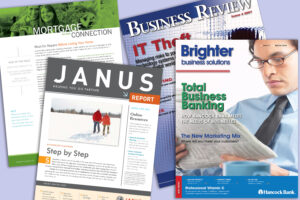
‘80s nostalgia has a special place for me because I graduated college in 1985 and took a job with a newsletter publishing company. It wasn’t my dream job — far from it — but I considered myself pretty luck that somebody was gonna pay me to write, even if it was for a decidedly unglamorous medium like bank newsletters.
There’s no way I could have known that job would lay the foundation for a writing career that has now stretched over 40 years. And that in 2026, I’d still be writing newsletters for banks and other financial services companies.
Of course, the newsletter format has changed considerably since 1985. Most newsletters today are distributed electronically instead of ink on paper, although some of my clients still distribute print newsletters through the mail. But regardless of the format, newsletters remain a viable marketing tool when used effectively.
I can personally attest to the power of newsletter marketing. I’ve now been publishing this e-newsletter, The Writer’s Block, for 15 years. Around 2016, I added a marketing agency to my distribution list after we had an introductory meeting. Five years later, they reached out and said they were ready to work together — and they remain one of my top clients today.
Stay Top-of-Mind
Newsletters utilize a strategy known as “drip marketing.” Like water dripping on a stone, your newsletter lands in a prospect’s mailbox or inbox on a regular basis. This keeps you and your business top-of-mind so prospects are more likely to think of you whenever they need whatever product or service you provide. Even if it’s five years later.
A well-crafted newsletter positions you and your business as subject matter experts, or SMEs as we marketers call them (what would we do without jargony acronyms?). By sharing insider experience and insights, you show customers and prospects that you’re a knowledgeable industry insider who can bring value to their project.
E-newsletter marketing is also highly cost-effective. Your only real costs are the content and distribution. And they scale really well — it’s doesn’t cost much more to send an issue to 10,000 people than it does to send it to 1,000 people.
Another benefit: Your newsletter can serve as a content creation engine that fuels other components of your content marketing program, including blogs, whitepapers and e-books. For example, I publish this content as an e-newsletter article and an article on LinkedIn the same day I click “send” on this newsletter.
Here are a few newsletter marketing tips I’ve picked up over my 40-year career:
-
Publish Consistently
In my opinion, if you can’t commit to a consistent publishing schedule, then don’t bother publishing a newsletter at all. So what’s the right frequency? This depends on several different factors including your industry, readership and available resources. The most important thing is to set a publishing schedule and then stick with it.
-
Focus on Quality
This goes without saying, right? Unfortunately, no. I’m always surprised by how many poorly produced newsletters I receive with everything from bad grammar and typos to crappy writing. If you don’t have a good writer on staff, hire a professional to write it for you, or at least to edit and proofread your copy. Ask for current writing samples that are relevant to your industry.
-
Make it Educational
The term we use in the industry is “value-added.” Your newsletter content should offer value to readers by teaching them things they don’t know based on your expertise. One rule of thumb is that 80% of your content should be value-added and 20% (or less) should be promotional. Otherwise, your newsletter will look less like a relationship building tool and more like a glorified advertisement.
-
Don’t Try to “Sell”
Remember that your newsletter is a marketing, not a sales, tool. Sure, you eventually want to sell stuff to your readers, but if you come across as too hard-sell, they will tune out and unsubscribe. For example, I offer helpful writing and marketing tips in hopes that you’ll remember me if you ever need to hire a freelance writer. That’s the extent of my sales pitch!
If you’re currently publishing a newsletter, think about how these tips could help you improve. If not, consider how newsletter marketing could benefit your business.